What Happens If Your Underground Oil Tank Fails Inspection After Removal in New Jersey?
September 1, 2026
If your underground oil tank fails inspection after removal in New Jersey, the contractor must report the spill to the New Jersey Department of Environmental Protection (NJDEP), soil samples are collected and sent to a lab, and depending on contamination levels, you may need additional sampling or full soil excavation before receiving a No Further Action letter to close the permit.
A homeowner recently called us while settling a family estate in Elizabeth, NJ. There was an underground oil tank on the property, and they had no idea what the removal process looked like — especially what would happen if something went wrong during inspection. It’s a question we hear often, and the answer involves a few moving parts.
At Tank Solutions, we walk homeowners through this process every day. Here’s exactly what to expect.
What Does the Inspection Actually Look For?
The fire sub code official from your township inspects the tank for visible holes, signs of contamination in the surrounding soil, and any odors coming from the excavation. This inspection happens the same day as the removal, once the tank is out of the ground.
If the inspector sees none of those warning signs, the tank passes and the permit can be closed out. If holes are present or contamination is visible, the tank fails. At that point, the process shifts into environmental territory.
What Happens Immediately After a Failed Inspection?
We contact the NJDEP and open what’s called a spill case or incident report. That terminology can sound alarming, but it’s standard procedure any time a removed tank shows signs of a release.
Within a few days, you’ll receive a form letter from the NJDEP with your case number. That letter confirms the incident is on file and the remediation process has officially begun. From there, soil testing determines your next steps.
Our licensed environmental team manages this reporting process on your behalf so nothing falls through the cracks.
How Do Soil Sample Results Determine What Comes Next?
The lab results from your soil samples determine whether you need a simple round of confirmatory sampling, additional delineation sampling, or full soil removal. Here’s how it breaks down:
- Below 1,000 (EPA TPH reading): You’re in good shape. A standard round of confirmatory samples is typically all that’s required.
- Between 1,000 and 5,300: Additional sampling rounds are required until all results fall below the NJDEP threshold. The number of samples depends on your tank size.
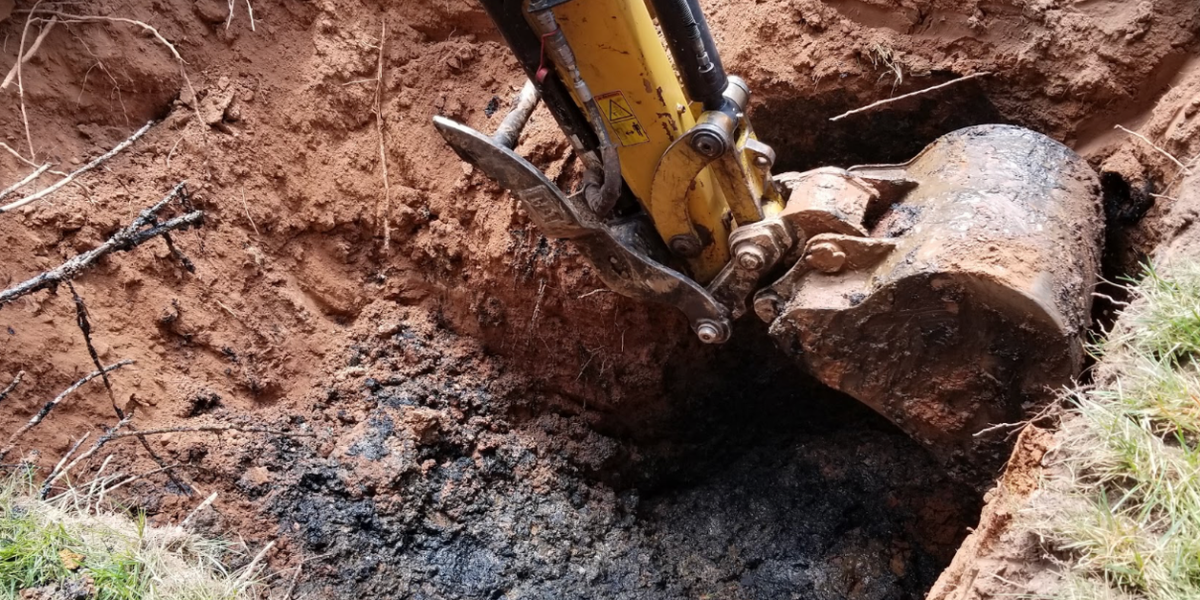
- Above 5,300 on any sample: The contaminated soil must physically come out of the ground. We excavate in increments, using a PID instrument on-site to detect when we’ve reached clean soil, then take final samples to confirm.
We also use that same PID instrument during the excavation to guide us in real time, so we’re not guessing about when to stop digging.
Learn more about how we handle this through our soil testing services.
What Is a No Further Action Letter and Why Does It Matter?
A No Further Action (NFA) letter is the official document from the NJDEP confirming that contamination has been remediated to acceptable levels and no additional work is required. It’s the finish line for any oil tank spill case in New Jersey.
Before that letter is issued, a licensed LSRP (Licensed Site Remediation Professional) or subsurface evaluator prepares a Remedial Action Report. That report compiles all sampling data and is submitted to the NJDEP for review. Once approved, the NFA letter is issued and submitted to your municipality along with the scrap receipt and tank manifest to officially close the permit.
Frequently Asked Questions
What if the tank was previously sand-filled? Does that change anything?
Yes, it adds some uncertainty. If a tank was decommissioned and sand-filled by a previous contractor, we still need to excavate and inspect it. The concern is whether the tank was properly cleaned before being filled with sand. If oil residue was left inside, the sand absorbs it and contamination can still be present even though the tank appears inactive. We assess this during excavation.
Who decides if the tank passes or fails — the inspector or the contractor?
The township’s fire sub code official makes the official call. That said, even if an inspector passes a tank, we’ll flag visible contamination if we see it. Our job is to protect you, not just check a box.
Do I need an engineer involved?
If soil remediation is required, yes. A licensed LSRP or subsurface evaluator must compile the Remedial Action Report and submit it to the NJDEP. We coordinate that process as part of our full-service approach to oil tank removal.
Get Guidance From a Team That Knows Elizabeth, NJ Oil Tank Regulations
Whether you’re settling an estate, preparing to sell a home, or just found out there’s a buried tank on your property, you don’t have to figure this out alone. Homeowners across Elizabeth, NJ and the surrounding area trust us to handle the permits, the inspections, the sampling, and everything in between.
Contact us today to talk through your situation and find out what to expect from start to finish.