
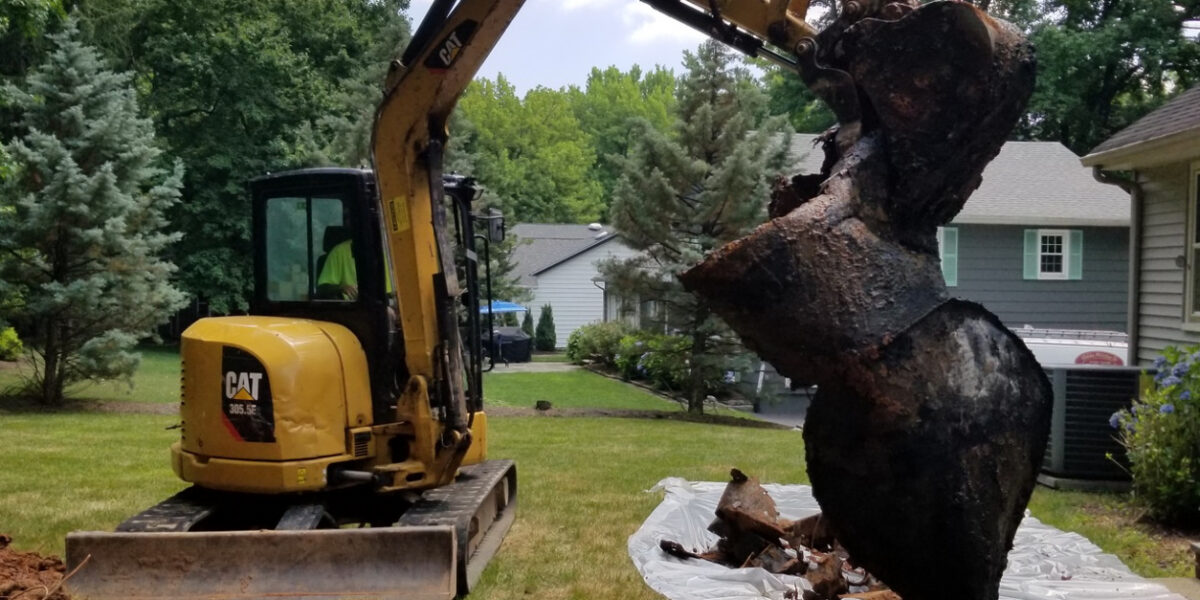
What Happens When Only Half an Underground Oil Tank Was Removed and Left Behind?
November 1, 2026
If only part of an underground oil tank was removed during past construction and the rest was left in the ground, you still have a problem that needs to be resolved. The remaining portion must be properly excavated, inspected for contamination, and removed with the correct permits before you can sell your home or consider the issue closed.
A homeowner in Berkeley Heights, NJ recently called us after discovering this exact situation. During construction back in the late 1990s, their underground oil tank had been cut in half. One section was removed, but the other was left buried outside near the rear of the house. Decades later, they were preparing to sell and a tank sweep revealed the buried remnant, partially sitting beneath a set of outdoor steps.
This kind of scenario is more common than most people realize. And it raises a lot of legitimate questions. Here is what you need to know.
Why Is a Partial Tank Left in the Ground Such a Big Deal?
A buried tank remnant carries the same environmental and legal risks as a full tank, sometimes more, because its condition and contents are unknown. When a tank is cut and left behind, there is no way to know what was inside it at the time. It could have been empty. It could have held residual oil, sludge, sand fill, foam, or water. Any of those materials can cause problems over time.
Even if the original removal crew believed the tank was empty, residual oil clings to the interior walls. Over years, a corroded steel shell can leak into surrounding soil. That contamination becomes your responsibility as the current property owner, regardless of who made the decision to leave it there.
Does It Matter That the Original Work Was Done Decades Ago?
The age of the work does not eliminate your obligation as a homeowner today. Regulations around underground storage tanks in New Jersey have tightened significantly over the years. What may have been overlooked or improperly handled in the 1990s does not get a pass now, especially when a property is being sold.
In most cases, a partial removal like this would have required a municipal permit and inspection at the time. If that permit was never pulled, there is no official record that any work was done properly. That gap in documentation becomes a red flag for buyers, attorneys, and lenders during a real estate transaction.
What Does the Removal Process Look Like for a Partial Tank?
Removing a tank remnant follows the same general process as a full underground oil tank removal, including permitting, excavation, soil assessment, and proper disposal. Here is what that typically involves:
- Pulling a permit with the local municipality before any work begins
- Excavating around the remaining tank section, even if it sits beneath a structure like steps or a patio
- Assessing the soil directly around and beneath the tank for contamination
- Removing the tank remnant and any contaminated material in compliance with New Jersey DEP standards
- Filing the proper closure documentation so you have a paper trail for the sale
If the tank is partially under a structure, that adds complexity to the excavation. It does not make removal impossible, but it does require experienced hands. Our licensed environmental team has handled situations like this and knows how to work around existing structures without unnecessary damage.
What About Soil Contamination Underneath the Old Tank?
Soil testing is a critical part of any partial tank removal because you cannot assume the ground beneath it is clean.If residual oil leaked over the years, the contamination may be limited, or it could have spread further than expected. Either way, you need to know before you close on a sale.
Our team handles both the physical oil tank removal and the environmental follow-up, so you are not coordinating multiple contractors or wondering if anything was missed.
Frequently Asked Questions
Do I need a permit even if this is just a partial tank?
Yes. Any underground tank removal in New Jersey, full or partial, requires a municipal permit. Without one, the work is not legal and will not satisfy a buyer’s due diligence requirements during a home sale.
Can I sell my home with a partial tank still buried on the property?
In most cases, no. Buyers, real estate attorneys, and lenders routinely flag underground tank issues. A buried tank remnant with no removal documentation is very likely to delay or kill a sale. Getting it removed properly is the cleaner path forward.
What if the tank is partially under my steps or a patio?
That adds a layer of complexity but does not prevent removal. An experienced contractor can assess how much of the structure needs to be modified or temporarily removed to access the tank safely. We do this kind of work regularly.
If you are dealing with a similar situation anywhere in the area, including homeowners near our serving communities across northern and central New Jersey, the right move is to get an expert on-site before you list your home or make assumptions about what is down there.
Get Your Partial Underground Oil Tank Removed Today
Ready to get answers? Contact us to schedule an assessment. We work with homeowners across Berkeley Heights, NJ and the surrounding region and will walk you through every step of the process from permitting to final documentation.